The nuclear family — mother, father, children — is not an accident of history.
Present or Absent: The Father’s Choice That Shapes Generations

He may have never given a TED talk or closed a merger. His name most likely won’t appear in any history book, and when he dies, the obituary will be three paragraphs in a local paper that nobody outside a twenty-mile radius will ever read.
But he taught a boy how to grip a baseball. He showed a daughter what it feels like to be safe. He got up at five-thirty every morning for thirty-four years, laced up steel-toed boots, and disappeared into a factory that took most of his hearing and two of his fingertips. He never once complained in front of the kids.
That man — the ordinary, unglamorous, persistently there father — is the load-bearing wall of civilization. And we are watching him disappear in real time.
📊 The Quiet Catastrophe
The numbers are not subtle. Roughly one in four children in the United States grows up without a biological father in the home. That is not a statistic. That is twenty-five million individual stories of absence. Twenty-five million bedtime routines with nobody checking the closet for monsters. Twenty-five million school plays with an empty seat stage-left.
And the downstream effects are not speculation. Fatherless homes correlate with virtually every negative outcome social science can measure: higher rates of poverty, behavioral disorders, academic failure, substance abuse, and incarceration.
The research is so consistent and so overwhelming that to ignore it requires active effort. Yet we have spent decades pretending that family structure is merely a lifestyle preference, like choosing between a sedan and an SUV.
It is not. A father is not a luxury item. He is not a nice-to-have accessory to the family project. He is, in ways both measurable and ineffable, irreplaceable.
The mother carries the child within her body for nine months. That bond is primal, biological, undeniable. The father must choose his bond. He must construct it through presence, through action, through the thousand small decisions that accumulate into something a child can lean their entire weight against.
That choice — the daily act of choosing his family over and over again — is what makes fatherhood distinct. It is what makes it sacred.
👣 The Shape of the Hole
What does a fatherless child actually lose? It is easy to list outcomes — graduation rates, income brackets, incarceration statistics — but statistics do not cry themselves to sleep. Statistics do not sit on the front steps at 7 PM, watching the street corner where a car used to pull up.
A child without a father loses something that is difficult to name and impossible to replace: the sense that there is a man in the world whose primary job is to stand between them and chaos. Mothers provide nurture, warmth, emotional anchoring. Fathers provide something different — a particular kind of structural integrity.
The father says, in effect:
The world is dangerous, but I am more dangerous. You are safe because I am here.
When that figure is absent, children do not simply adapt. They compensate. Boys without fathers often construct a performative masculinity, a hollow shell of toughness that cracks under pressure because nobody ever taught them that real strength is restraint, not rage. Girls without fathers often spend decades searching for male validation in all the wrong places, having never experienced what it feels like to be loved by a man who expects nothing in return.
The absence is not neutral. Nature abhors a vacuum, and the space where a father should be gets filled by something — often by the worst the culture has to offer. Street crews become surrogate families. Influencers become role models.
Pornography becomes sex education. The algorithm raises the child.
🔨 What Fathers Actually Do
Let us strip away the sentimentality and look at the mechanics. What does a present father contribute that cannot be replicated by a well-intentioned single mother, a village, a government program?
The father is the first Other. For an infant, the mother is extension of self — warmth, milk, heartbeat, everything. The father is the first person the child recognizes as separate. He is the bridge between the domestic sphere and the world beyond. He introduces the concept that there are people outside the maternal dyad, and those people can be trusted.
The father teaches risk calibration. Mothers tend toward protection. Fathers tend toward controlled exposure. Watch a father at a playground: he is the one throwing the child slightly higher than the mother would prefer, encouraging the jump from the third step, standing back while the toddler figures out how to navigate the climbing structure. This is not recklessness. This is the systematic development of competence.
The child learns: I can do difficult things. I can fall and get back up. The world will not catch me every single time, and that is okay.
The father models self-regulation. Boys who grow up with present fathers have lower testosterone spikes during conflict.
They learn that masculinity is not about impulse but about discipline. They watch a man get frustrated, take a breath, and respond with control rather than explosion. This is not taught through lectures. It is absorbed through observation, year after year.
The father sets the standard for how men treat women. A daughter’s template for male behavior is written primarily by her father. If he is gentle, consistent, and respectful, she will recognize those qualities — and their absence — for the rest of her life. If he is absent, cruel, or dismissive, she will spend decades trying to rewrite that template, often with men who resemble the original.
The father provides the weight. There is a reason children of single mothers often describe a particular kind of exhaustion in their parent — not just the physical exhaustion of doing everything alone, but the psychological exhaustion of being the sole decision-maker, the sole provider, the sole authority. The father, when present, shares that weight. He is the second pillar. The house does not collapse if one pillar weakens.
💔 The Wound That Shapes a Life
The father wound is not a metaphor. It is a real thing, carried in the nervous system, encoded in attachment patterns, expressed in relationships, careers, and self-concept.
A boy who grows up without a father often carries a particular kind of rage — a low-frequency hum of anger that he cannot always explain. He is angry at the man who left. He is angry at his mother for not being enough. He is angry at himself for caring. And because nobody taught him how to metabolize anger, it leaks out sideways — into fights, into addictions, into a general posture of defiance toward any authority figure who might, if given the chance, disappoint him.
A girl who grows up without a father often carries a particular kind of hunger — a bottomless need for male attention that she experiences as shameful and inescapable. She confuses intensity with intimacy. She confuses being wanted with being valued. She gives herself away cheaply because nobody ever demonstrated what it looks like when a man treats a woman as precious. She does not know what she is worth because the first man in her life never bothered to tell her.
These are not moral judgments. They are descriptions of what happens when a fundamental human need goes unmet. The child is not at fault. The child is never at fault. But the child becomes the adult who must do the brutal work of healing a wound they did not create.
🦸♂️ The Men Who Didn’t Have To Be
And then there is a particular kind of man who deserves his own category of honor.
The stepfather enters a story already in progress. The characters are established. The plot has already taken difficult turns. The biological father may still be in the picture, or he may be a ghost, or he may be something worse — a recurring source of chaos and disappointment. The children are wary. They have learned that men leave, or that men hurt, or that men are not to be trusted.
The stepfather walks into this situation voluntarily. Nobody forced him. Biology did not compel him. He looked at a woman with children from another man and said: I choose all of you.
He will attend parent-teacher conferences for children who share none of his DNA. He will pay for braces, for school supplies, for prom dresses, for college applications. He will discipline children who may throw his lack of biological connection in his face during arguments. He will sit through awkward visitations with ex-husbands. He will be called “Steve” for five years before he is ever called “Dad,” and that transition, if it comes at all, will arrive without ceremony.
And here is the thing that separates the real stepfather from the mere occupant of the role: he does not demand gratitude.
He does not keep a ledger. He does not say, After everything I’ve done for you. He understands that love, in this context, means giving without guarantee of return. It means showing up for a child who may never fully accept him, and doing it anyway, because that is what the child needs.
The stepfather who “didn’t have to be” embodies something profound about the nature of fatherhood itself. He reveals that fatherhood is not primarily about biology. It is about choice. It is about the daily decision to prioritize the welfare of a child over comfort, over ego, over the easy path.
The biological father who stays makes that choice too, but it is obscured by the natural connection. The stepfather has no biological fog to hide behind. His choice is naked, unmistakable, undeniable. Every single day, he chooses to be a father to children who are not his own. That is not a diminished form of fatherhood. That is fatherhood in its purest expression.
🧬 The Invisible Architecture
There is a tendency in modern discourse to treat the family as an arbitrary social arrangement, one configuration among many, equally valid and interchangeable. This is well-intentioned nonsense.
The nuclear family — mother, father, children — is not an accident of history. It is the product of millions of years of evolutionary pressure, refined across thousands of human cultures, and it persists because it works. It provides children with two complementary sources of investment, two different models of adulthood, two distinct forms of love and discipline and presence.
When we lose the father, we lose half the architecture. The single mother can be heroic — and many are, performing miracles of sacrifice and endurance that deserve nothing but admiration. But she cannot be two people. She cannot simultaneously provide the maternal warmth and the paternal structure. She cannot model both femininity and masculinity.
She cannot be the nurturer and the boundary-setter in equal measure without exhausting herself to the point of collapse.
The question is not whether single mothers are adequate. The question is whether we, as a society, are willing to admit that children deserve more than adequate. They deserve the full architecture. They deserve both parents. And when that is not possible — through death, through abandonment, through circumstances beyond anyone’s control — they deserve a culture that treats that absence as a loss to be mourned and mitigated, not a lifestyle choice to be celebrated.
🌅 The Redemption
But this is not a eulogy. This is a Father’s Day reflection, and Father’s Day is about celebration, not lament.
The story of fatherhood in the twenty-first century is not only a story of absence. It is also a story of men who are more present, more engaged, more emotionally available than any generation of fathers in human history. The fathers who are showing up are showing up harder than ever before.
They are changing diapers and packing lunches. They are coaching soccer teams and leading Scout troops. They are having difficult conversations about sex, about drugs, about the internet, about the future. They are saying “I love you” without irony or reservation. They are doing the work.
And the stepfathers — the men who didn’t have to be — are doing it without biology, without obligation, without the cultural scripts that guide biological fathers. They are inventing fatherhood as they go, building relationships from scratch, earning trust that was not automatically granted.
If you are one of these men, hear this: you are seen. The quiet consistency of your presence registers. The sacrifices you make — the overtime shifts, the missed promotions, the hobbies abandoned, the sleep lost — are not invisible. They are the foundation upon which a human being is built.
Your children may not articulate it. They may not fully understand what you have given them until they are thirty years old, holding their own child, suddenly flooded with the realization of what it cost you. But that realization will come. And when it does, it will hit them like a wave.
🕯️ For the Fathers We Lost
Some of us are celebrating fathers who are no longer here. Some of us are mourning fathers we never had. Some of us are trying to become fathers while still healing from the fathers who failed us.
If your father is gone — through death or distance or the slow erosion of time — today is hard. The greeting card industry does not know what to do with your grief. There is no card for I miss you in ways I cannot explain to people who still have you. There is no card for I am still angry and I don’t know if that’s okay. There is no card for I am trying to be the father you weren’t and it is the hardest thing I have ever done.
But here is what you need to know: the cycle can break with you. The absence can end with you. Whatever you did not receive, you can give. Whatever wound was inflicted, you can heal — not by erasing it, but by ensuring it is not passed forward.
This is the terrible gift of the father wound: it teaches you exactly what a child needs, because you remember the shape of the absence. You know where the hole is. You can fill it for someone else.
🎖️ A Charge to Fathers
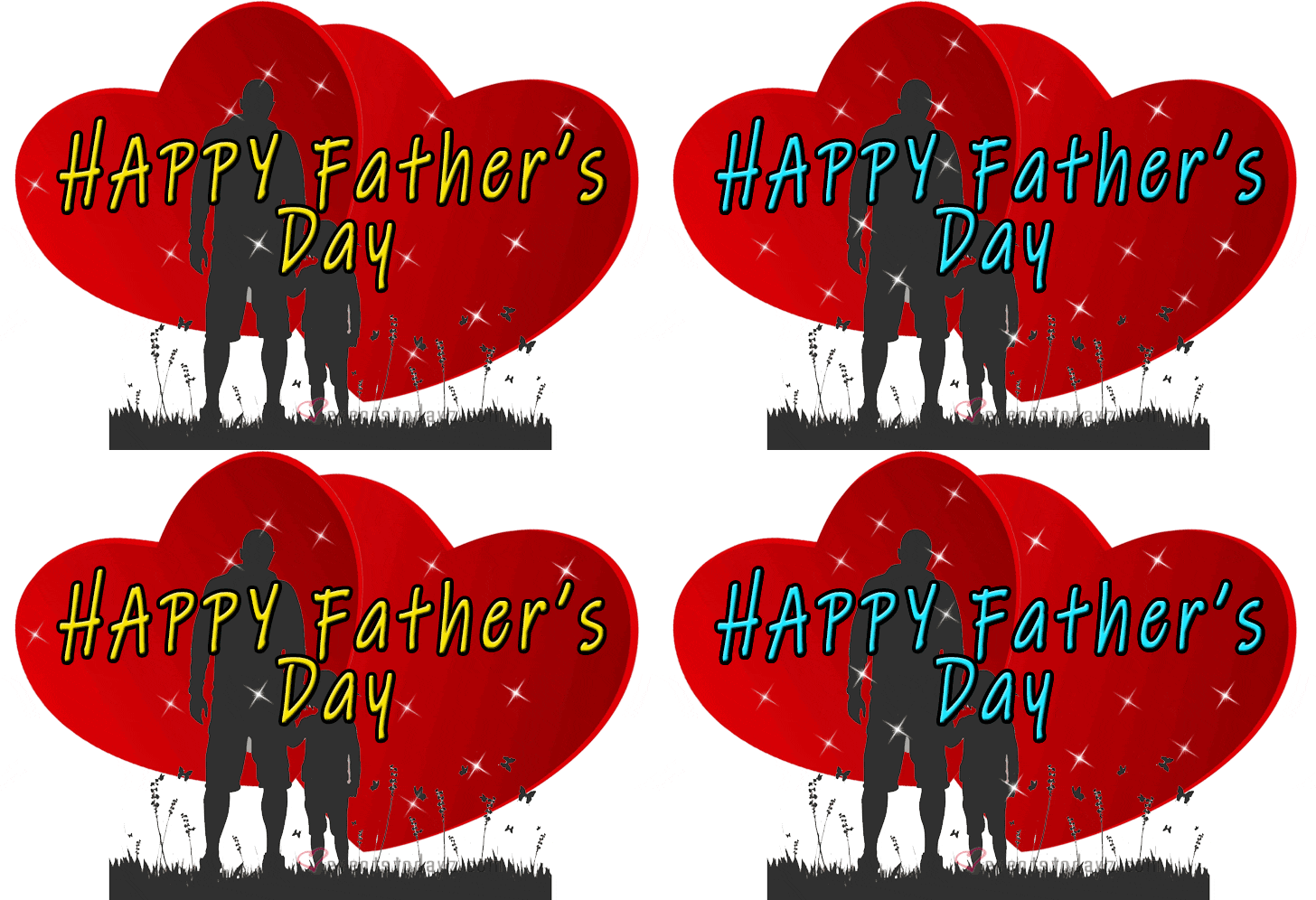
So here, on Father’s Day, is the charge:
Be present. Not just physically — that is the minimum, the floor, the bare requirement — but emotionally, psychologically, spiritually present. Put down the phone. Turn off the game. Look at your children. Listen to them. Not the quick, distracted listening where you nod while thinking about work. The real listening, where you follow up, where you ask questions, where you remember the names of their friends and the plots of their favorite shows and the thing they were worried about last Tuesday.
Be consistent. Children do not need perfection. They need predictability. They need to know that you will be there, that you will keep your promises, that your mood will not swing wildly based on factors they cannot control. Consistency is not flashy. Consistency does not go viral. But consistency is the bedrock upon which a child’s sense of security is built. Be the same man on Tuesday that you were on Monday. Be the same man at home that you are in public. Your children are watching both versions, and they notice the gap.
Be gentle. The world will be harsh to them. They do not need you to be an additional source of hardness. They need you to be the place where they can be soft. They need to know that failure is survivable, that mistakes are forgivable, that your love is not contingent on their performance. Discipline is necessary — a father who never says no is not a father, he is a friend — but discipline without gentleness is just cruelty. The goal is not obedience. The goal is the development of a moral conscience, an internal compass that will guide them when you are no longer there to guide them yourself.
Be humble. Apologize when you are wrong. Admit when you do not know. Let your children see you struggle, fail, and recover. They do not need a superhero. They need a human being who models how to navigate difficulty with integrity. The father who never admits fault teaches his children that fault is shameful. The father who owns his mistakes teaches his children that mistakes are how we grow.
Be worthy. The title of “Dad” is not conferred by biology. It is earned through action. It is renewed every single day. You do not get to coast on yesterday’s effort. Your children are growing, changing, facing new challenges, and they need a father who grows with them. The father of a toddler is not the same as the father of a teenager is not the same as the father of a young adult. The role evolves. You must evolve with it.
🕊️ The Legacy
At the end of your life, you will not care about your portfolio. You will not care about your job title, your square footage, your collection of whatever it is you collected. You will care about whether you showed up. Whether you were there for the moments that mattered. Whether your children know, in their bones, that they were loved by their father.
That is the legacy. Not money. Not achievements. Not the things you acquired. The legacy is the feeling your children carry with them for the rest of their lives — the feeling of being seen, being valued, being safe. That feeling becomes the foundation upon which they build their own families, their own identities, their own capacity to love.
A good father does not just raise children. He raises adults who can raise children of their own. He creates a chain of presence that extends forward through generations he will never meet. His great-grandchildren will benefit from his choices, even if they never learn his name. That is the scale of what is at stake.
🙏 A Blessing for Father’s Day
To the fathers who stayed: thank you. The world does not celebrate you loudly enough. The culture does not honor you with the weight you deserve. But your children know. And their children will know. And the civilization that depends on your quiet, persistent presence will continue, in large part, because of you.
To the stepfathers who chose to love children not their own: you are the living proof that fatherhood transcends biology.
You are the argument against cynicism. You are the evidence that men can be tender, can be steadfast, can be fathers in the fullest sense of the word, even without blood ties. What you have done will echo.
To the single mothers doing the work of two: you are seen. You are not forgotten. The difficulty of your task is not minimized by anything written here. You deserve support, recognition, and the knowledge that your sacrifice matters. Your children are blessed to have you.
To those missing a father today: the ache is real. The absence is not nothing. But it does not define you. You are not broken. You are not doomed to repeat the patterns that hurt you. Healing is possible. Wholeness is possible. The wound can become a source of strength, of compassion, of fierce determination to be for others what nobody was for you.
And to the fathers who are gone — who have passed beyond this life into whatever comes next — you are remembered. The lessons you taught, the love you gave, the example you set: these things do not die. They live on in the children you raised, in the values you instilled, in the thousand small ways your influence continues to ripple outward through the lives of everyone who loved you.
Happy Father’s Day.
Go call your dad.
Other Cool Clean Posts:

Pages: 1 2