A Tribute To The Man, Warrior and Legend … The Real Walker, Texas Ranger …
A Life of Strength and Honor: In Memory of Chuck Norris

When the world speaks of strength, courage, and integrity, very few names evoke universal respect. One of those names is Chuck Norris — an American icon whose legacy transcends martial arts, screen action, and pop culture itself. His life story embodies not just personal triumph but the timeless virtues of discipline, patriotism, humility, and faith.
Chuck Norris’s passing marks not only the end of a cultural era, but also the celebration of a man who lived life with an unwavering commitment to both body and soul — a man who inspired millions to believe that power and goodness could coexist.
🧒 Early Life: From Poverty to Purpose
Carlos Ray Norris was born on March 10, 1940, in Ryan, Oklahoma, during the tough final years of the Great Depression. His father, Ray Norris, was a World War II veteran and mechanic whose battle with alcoholism strained the family. His mother, Wilma Scarberry Norris, a woman of deep Christian faith, became Chuck’s moral and emotional foundation.
When Chuck was just sixteen, his parents divorced, and Wilma raised Chuck and his two younger brothers — Wieland and Aaron — in poverty. Those hardships carved into Chuck an early understanding of resilience and responsibility.
Norris often recalled in interviews that he wasn’t a naturally gifted child. He described himself as shy, small, and academically average. He lacked confidence — until life called him to grow up faster than most boys his age. The military would change that.
🇺🇸 The Turning Point: The Air Force and a Discovery in Korea

In 1958, at the age of 18, Chuck Norris joined the United States Air Force. Stationed at Osan Air Base in South Korea, Norris worked as an Air Policeman. It was there, amidst the foreign dust and discipline of military life, that Chuck was first introduced to Tang Soo Do, a traditional Korean martial art emphasizing hard strikes, precision, and respect.
That single discovery sparked what would become a lifelong pursuit — not of violence, but of mastery. Norris poured himself into his training with the same discipline that defined the Air Force ethos: repetition, perseverance, and humility. Tang Soo Do became not just a fighting system but a personal philosophy.
By the time he returned to the United States, he had earned black belts in Tang Soo Do and Taekwondo, setting the stage for his next chapter: building something of his own.
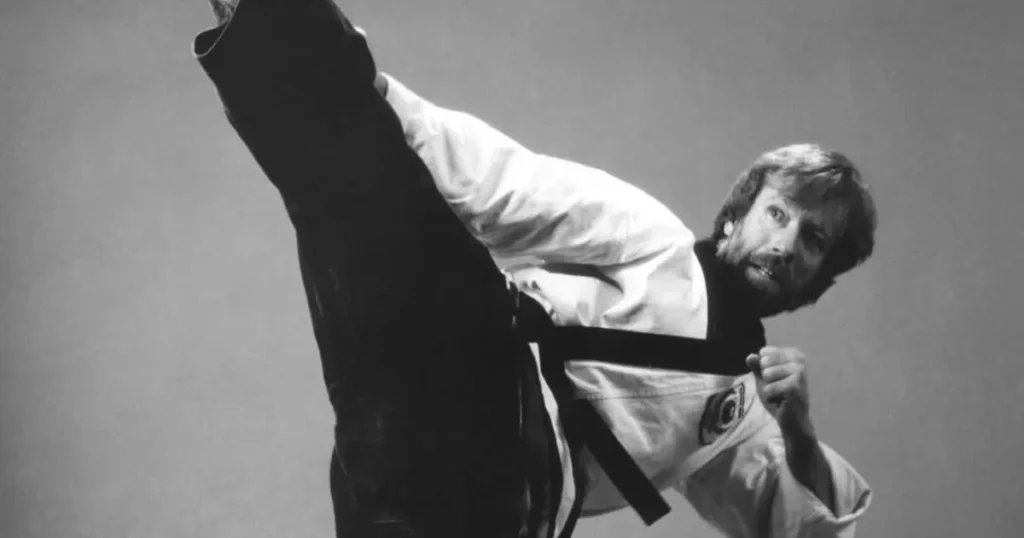
🥋 The Martial Artist: Building an American Spirit
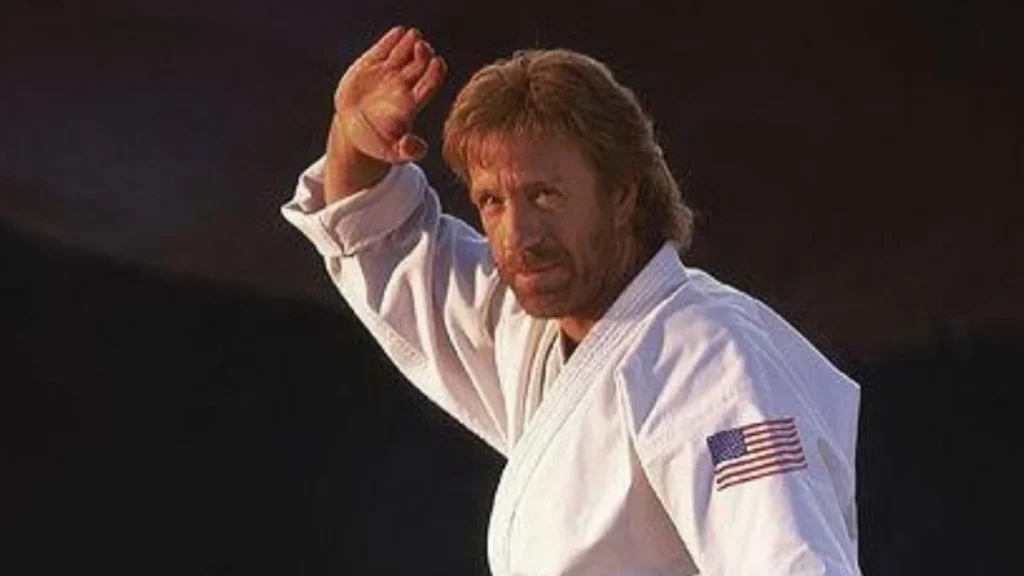
In the early 1960s, Norris opened his first karate school in Torrance, California. At first, few understood or respected martial arts in America — it was a niche for soldiers returning from Asia or movie stuntmen. Chuck’s natural charisma, patience, and dedication turned skepticism into fascination.
Over the next decade, Norris competed at the highest levels of martial arts. He won his first Professional Middleweight Karate Championship in 1968 and held it for six consecutive years. His opponents — including legends like Joe Lewis and Skipper Mullins — respected his calm intensity. His students admired his humility.
In 1969, Norris was named Black Belt Magazine’s Fighter of the Year, cementing his reputation not only as a skilled fighter but as a teacher and pioneer who helped popularize martial arts across the United States.
Out of his teaching came something far more powerful than trophies — a movement. Through discipline, physical training, and moral clarity, Norris helped shape an entire generation of Americans who saw martial arts as a path to self-respect, discipline, and virtue, not aggression.
🎬 Hollywood: From Sidekick to Star

Like many veterans with ambition, Chuck dreamed of doing something bigger. One of his early students happened to be Steve McQueen, the “King of Cool” himself, who encouraged Chuck to pursue acting. “You’ve got the presence,” McQueen told him. “You should be in movies.”
So he did.
In 1972, Norris appeared opposite Bruce Lee in Way of the Dragon (Return of the Dragon in the U.S.), playing the formidable Colt, an American martial artist who battles Lee’s character in one of the most iconic fight scenes in cinema history — filmed in Rome’s Colosseum. That moment cemented his entry into Hollywood.
By the mid-1970s, Chuck Norris had established himself as more than just a martial artist on screen. He starred in films such as:
Good Guys Wear Black (1978)
A Force of One (1979)
The Octagon (1980)
Lone Wolf McQuade (1983)
Each role was a blend of stoic strength, patriotism, and justice. Unlike the ultra-violent antiheroes popular in later decades, Norris portrayed men who fought not out of bloodlust, but duty.
🔥 The Action Star and the Everyman Hero

When the 1980s arrived, Chuck Norris had become a household name. Working with Cannon Films, he starred in a series of high-octane action hits that defined the decade’s spirit of American resilience and courage.
Movies like Missing in Action (1984) and The Delta Force (1986) weren’t just action spectacles — they were reflections of a cultural mood. After the Vietnam War, America struggled to reconcile pride with pain. Norris’s roles often portrayed the embodiment of post-war redemption: the soldier who returns to rescue the forgotten, the man who refuses to quit.
Audiences saw in him what they wanted to see in themselves — honor, strength, and moral certainty in a world of confusion.
Yet, despite his success, Norris refused to indulge in the excesses that defined much of 1980s Hollywood. He avoided drugs, public scandals, and ego. On set, he was known for his kindness and discipline. Crew members remembered him as “the guy who thanked everyone by name.”
In an age of celebrity decadence, Norris was different: a man who never forgot where he came from.
🕊️ The Tragedies That Forged His Faith
Fame never insulated Chuck Norris from suffering. His younger brother Wieland, a soldier in the Vietnam War, was killed in action in 1970. Chuck never spoke of it publicly for decades, but friends close to him said that it changed him permanently. Wieland’s death drove Chuck deeper into contemplation — about war, justice, and the fragility of life.
Norris later said: “My brother was the real hero. I just tell stories on screen — he lived one.”
As years passed, Chuck leaned increasingly on his Christian faith. Raised by a devout mother who prayed for him daily, he began studying Scripture more seriously and integrating faith-based themes into his later work.
🌟 Walker, Texas Ranger: The Philosopher with a Badge
In 1993, television audiences met Cordell Walker, a modern-day Texas lawman with a black belt, a Stetson hat, and a Bible in his saddlebag.
Walker, Texas Ranger ran for eight seasons and became a global hit. It reached viewers in over 100 countries, airing in syndication long after its finale in 2001. What made the show so unique was its combination of action and morality.Each episode carried a lesson about values — faith, justice, community, and redemption.
For Norris, the show wasn’t just entertainment; it was a platform to model virtue. Episodes often ended with characters making moral choices — sometimes with a prayer, sometimes with forgiveness. It drew criticism from cynics but struck a deep chord with families looking for something wholesome.
In a Hollywood flooded with moral ambiguity, Walker, Texas Ranger stood firm, reflecting what Chuck Norris had lived by: good wins, evil fails, and truth matters.
📚 The Author and Philosopher
Beyond the screen, Chuck Norris was prolific as a writer. His books — The Secret of Inner Strength (1988), Against All Odds (2004), and Black Belt Patriotism (2008) — blended personal stories with philosophies on health, ethics, and liberty.
He also authored Christian devotionals and even children’s books focused on self-esteem and good moral choices. His core theme was always self-responsibility. In a culture increasingly drawn to victimhood, Norris preached empowerment:
“A man’s only limits are the ones he places on himself.”
His commentary columns — published in outlets like WorldNetDaily — revealed an intellectually curious side of Norris often overshadowed by the machismo of his image. He wrote about education, family, government responsibility, and faith with clarity and conviction.
💖 Family, Faith, and the Norris Code

Chuck Norris married Dianne Holechek in 1958 while serving in the military. They had two sons, Mike and Eric, both of whom followed him into film. Though their marriage ended in 1989, Norris remained deeply devoted to his family.
In 1998, he married Gena O’Kelley, a former model and strong Christian woman. Their marriage became one of Hollywood’s rare examples of enduring faithfulness and mutual respect. Together they had twins, Dakota and Danilee.
In the 2010s, when Gena suffered severe health complications allegedly triggered by medical imaging contrast agents, Chuck became her fiercest advocate. He spent millions fighting for her recovery and publicly campaigned for greater transparency about medical risks — a testament to his loyalty and courage to speak out against powerful pharmaceutical interests.
Through personal struggle, Norris again revealed his core nature: a protector, not a victim.
🌎 Philanthropy and Patriotism
Chuck Norris believed that real strength must serve others. He founded several charitable organizations, including:
Kickstart Kids (originally Kick Drugs Out of America): teaching martial arts and character education to youth in public schools to develop discipline and avoid drugs and gang culture.
Make-A-Wish Foundation collaborations: fulfilling countless wishes for children with terminal illnesses.
United Way and Veterans’ charities: Norris frequently visited military bases, hospitals, and schools, offering time, not just money.
In 2007, the U.S. Veterans Administration recognized him as an Honored American Patriot, and in 2010, he received a rare Honorary Texas Ranger Commission, formalizing what many Texans already felt — that he was Walker in spirit.
He also advocated tirelessly for veterans’ mental health support, long before it became a national conversation. His love for America was not political theater; it was personal. Norris lived by the belief that patriotism meant gratitude and responsibility — gratitude for freedom and responsibility to preserve it.
💪 The “Chuck Norris Facts” Phenomenon
In the early 2000s, a humorous internet trend catapulted Norris back into pop culture: the“Chuck Norris Facts.”
Lines like “Chuck Norris doesn’t do push-ups — he pushes the Earth down” became viral memes long before social media was mainstream. Younger generations who hadn’t grown up with Walker or his action films were suddenly fascinated by his mythical toughness.
“Chuck Norris can hear sign language.”

Rather than resist or mock the trend, Norris embraced it with humor and class. He laughed at the jokes but used the moment to promote charity and positive values, writing:
“They’re funny, but I also hope people remember that real strength comes from faith, family, and doing what’s right — not just roundhouse kicks.”
“Chuck Norris caught corona virus. Now he has it chained up in his backyard.”

His humility turned what could have been a fleeting meme into a lasting symbol of self-confidence and character.
🏛️ The Statesman of Integrity
As he grew older, Chuck Norris became not just a celebrity but a voice of conscience in public life. His commentaries emphasized faith, personal responsibility, limited government, and respect for the Constitution.
Unlike divisive pundits, his tone was calm but firm. He didn’t shout — he reasoned. He approached debates not from ideology, but conviction. His world view combined traditional Christian ethics with a belief in self-mastery, liberty, and civic duty.
Though Norris supported conservative causes and candidates, he often emphasized respect for opponents and discouraged polarization. He reminded Americans that spiritual strength mattered more than party loyalty.
His moral compass never wavered: principles before popularity.
🕯️ The Final Years: Strength in Grace
In his later years, Chuck Norris slowed his public appearances but never his devotion to others. He remained active in charity work, mentoring, and Christian outreach.
Even after retiring from the screen, his presence remained magnetic. Whether visiting troops, attending church events, or quietly training in his home gym, Norris represented the rare archetype of a man who aged with dignity — not decay.
Those close to him say that in his final years, he devoted more time to reflection and prayer. He often said he’d lived a blessed life — a phrase never uttered out of guilt, but of gratitude.
He maintained his hallmark humor until the end. Asked once what he wanted his epitaph to be, he smiled and said:
“When Chuck Norris dies, death will write its own obituary.”
And yet, for all the jokes about his invincibility, the truth is this: he was mortal, but left an immortal mark. His passing leaves a profound void — but a trail of light for others to follow.
🌠 Legacy: More Than a Legend

Chuck Norris’s story defies easy categorization. He was:
A military veteran who never sought glory.
A world champion martial artist who taught humility above competition.
A Hollywood icon who rejected empty fame.
A Christian who lived his faith quietly but courageously.
A philanthropist who transformed thousands of young lives.
He achieved everything our age pretends to admire but seldom understands — discipline, integrity, courage, perseverance, and spiritual grounding.
His life offers lessons deeper than his catchphrases: that power is nothing without purpose, and that the strongest man is one who kneels before God.
In an era obsessed with self-promotion and cynicism, Chuck Norris represented the old code — that unspoken American principle that doing what’s right matters more than doing what’s easy.
🌄 A Final Reflection

For those who grew up watching Walker, Texas Ranger at their grandparents’ house, or cheering through Delta Force marathons, or sharing “Chuck Norris Facts” in middle school textbooks, there’s a sense today that part of goodness itself went with him.
“Chuck Norris had a staring contest with the sun and won.”

But in truth, Norris’s legacy lives precisely where he wanted it to — in others. In every young person who finds courage to stand up to a bully, in every veteran who reclaims dignity through perseverance, in every father who leads with strength and love — there is a piece of Chuck Norris alive.
His martial arts schools continue to train new generations; his program Kickstart Kids thrives; and his written words still inspire readers to seek moral clarity in a fogged and frightened world.
He once wrote:
“I don’t measure a man’s success by how high he climbs, but by how high he bounces when he hits bottom.”
By that measure, Chuck Norris was one of the greatest successes America ever produced.
🕊️ Farewell to a True Warrior
When the final credits rolled on his life, Chuck Norris left behind more than films — he left behind a framework for living. Strength and kindness. Justice and mercy. Power and humility.
His memory will persist in both legend and truth, as a man who turned hardship into discipline, discipline into mastery, and mastery into service.
He showed that the purpose of strength is not domination, but protection — that the ultimate victory lies not in defeating others, but in defeating oneself.
In that, the legend of Chuck Norris will never die.
Eternal Rest, Carlos Ray Norris (1940–2026)
A man who proved that true power comes from faith, love, and unshakeable character.
Other Cool Clean Posts: